Bombed in Daylight: Thailand’s F-16s Strike 70 Kilometers Inside Cambodia
 Bombed in Daylight: Thailand’s F-16s Strike 70 Kilometers Inside Cambodia
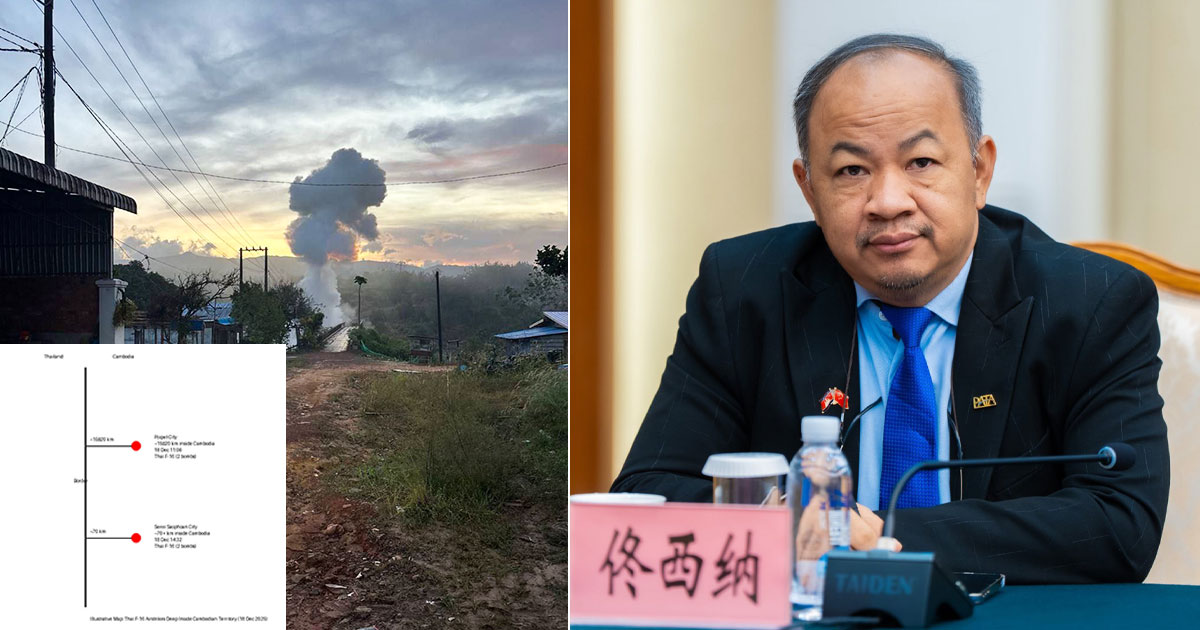
On 18 December 2025, Thailand carried out two separate airstrikes against Cambodian cities in broad daylight. These were not border skirmishes. They were deliberate attacks inside Cambodian territory, far beyond any line that could honestly be described as “defensive.”
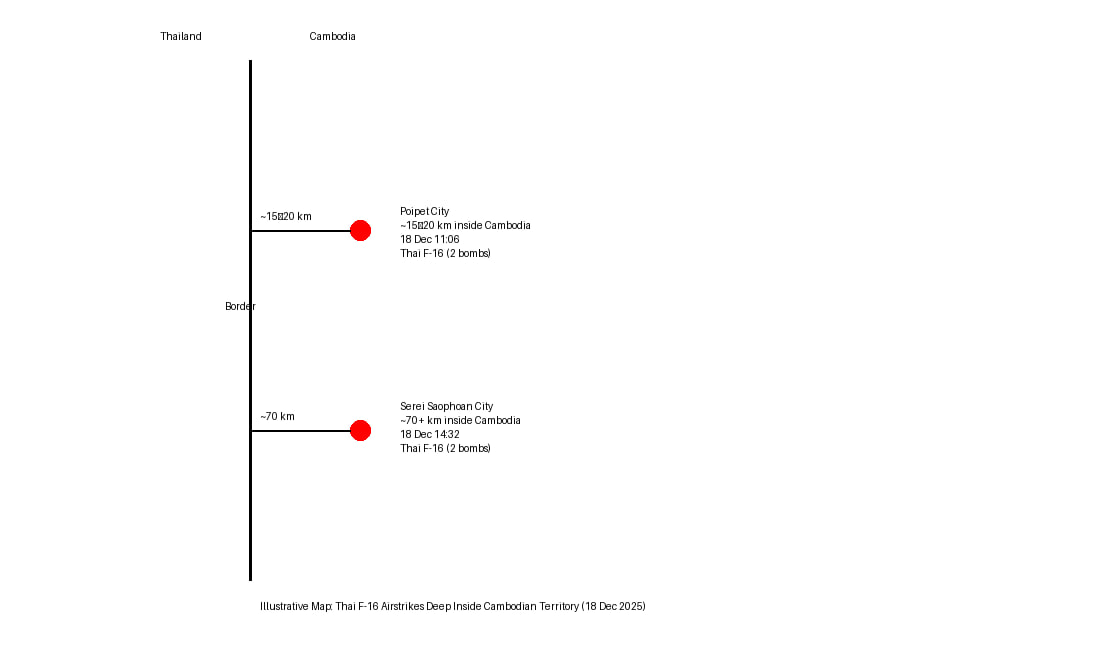
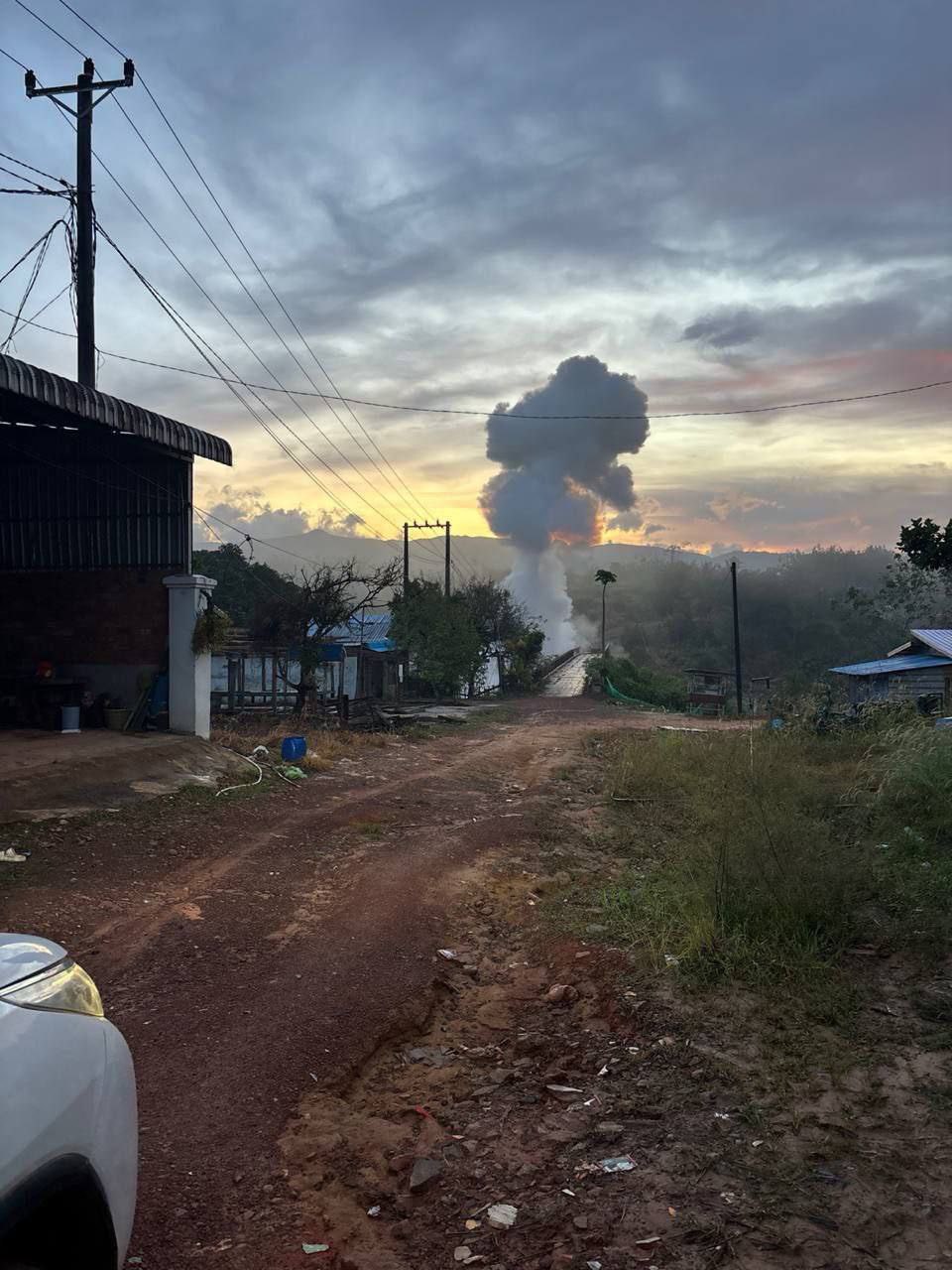
At 11:06 a.m., Thai forces used F-16 fighter jets to drop two bombs on Poipet City, Banteay Meanchey Province. Poipet is a civilian city. The impact area was inside Cambodia — not a military zone, not a battlefield, not a casino, and not an online scamming building.
Then at 2:32 p.m., Thai F-16 aircraft again dropped two bombs on Serei Saophoan City, also in Banteay Meanchey Province. This second strike cannot be explained away. Serei Saophoan lies at least 70 kilometers inside Cambodian territory, well beyond the Thai–Cambodian border. No credible military doctrine can describe this as a border incident. This was deep-territory bombing.
Schools, residential neighborhoods, local product warehouses, bridges, pagodas, temples, and public buildings were hit or damaged. Civilians were present. Daily life was ongoing. This was not night combat, not confusion, not crossfire. It was daylight bombing of cities.
Within hours, Thailand’s military claimed it was only targeting “military bases and scamming-related buildings.” That statement was immediately echoed by English-language Thai media, including Khaosod English, The Nation, and the Bangkok Post, often without independent verification, without on-site reporting, and without acknowledging what the facts on the ground showed: civilian infrastructure was struck.
This is not journalism. It is quotation without responsibility.
By repeating military posts as news, these outlets mislead both Thai citizens and international readers who assume English-language reporting means independent scrutiny. In this case, it does not. It means amplifying an illegal narrative.
There were no Cambodian military bases at the impact sites. There were no casinos. There were no online scamming buildings. What was hit were schools, homes, bridges, warehouses, religious sites, and public facilities. Calling this “targeted anti-crime action” does not change the reality. It hides it.
International law does not work the way Thailand now suggests. No state has the right to bomb another sovereign country by accusing it of criminal activity. If cybercrime is the concern, the tools are investigation, cross-border police cooperation, and courts — not fighter jets. Accepting Thailand’s logic would mean any powerful country could bomb weaker neighbors simply by inventing accusations.
Even Thailand’s own messaging reveals the strategy. Thai officials and media have increasingly tried to reframe the fighting as a “war on scammers,” a narrative noted by international observers including The Japan Times. This rebranding is not accountability; it is camouflage. It changes the headline from invasion to crime control, hoping global audiences stop asking the simplest questions: why are schools bombed, why are bridges destroyed, why are pagodas hit, why are warehouses burned?
The “anti-scam” justification becomes even harder to accept when placed in regional context. The UN Office of the High Commissioner for Human Rights has warned that online scam operations across Southeast Asia are deeply intertwined with human trafficking, corruption, and protection networks, and that states must address bribery and investigate officials suspected of complicity (OHCHR Bangkok). In Thailand itself, domestic reporting has repeatedly described scandals involving senior figures, ministers or MPs, and large numbers of police officers linked to underground businesses, including online gambling and corruption (The Nation Thailand).
More specifically, in late 2025 multiple outlets reported allegations by a former Thai police officer that senior figures in the governing Bhumjaithai Party had accepted benefits linked to Cambodian casinos — claims that were publicly denied but have never been resolved through transparent, independent inquiry (The Thaiger). These reports matter not because allegations equal guilt — they do not — but because they expose the hypocrisy of bombing Cambodia in the name of fighting crime while serious claims about cross-border “grey money” and protection networks remain unanswered at home.
So the question the world must ask is simple: if Thailand truly wants to fight transnational scamming, why not welcome international cooperation and scrutiny? Why not support neutral investigations, publish evidence, and pursue lawful cross-border enforcement? Why choose bombs — and then demand applause?
Khmer wisdom has long warned against this behavior: “ស្វាស៊ីបាយលាបមាត់ពពែ.” The monkey eats the rice, then wipes its mouth on the goat. Commit the act, then blame someone else.
Thailand drops the bombs.
Cambodian civilians suffer.
Cambodia is accused.
What Thailand claims it does not target, it continues to destroy: schools, temples, homes, bridges, warehouses, public buildings. These are not isolated errors. They form a pattern. And when media continue to publish official claims while ignoring that pattern, they are no longer observers. They become part of the distortion.
Cambodia is small, economically weaker, and militarily limited. That makes it easier to bomb — and easier to misrepresent. But weakness does not erase sovereignty, and silence does not erase crime.
Poipet is not collateral damage.
Serei Saophoan is not a border accident.
Cambodian children are not acceptable losses.
The bombs fell twice on 18 December. One strike near the border. One strike dozens of kilometers inside Cambodia. The facts are plain. The geography is undeniable. What remains is a question for the world: will truth still matter when lies are repeated loudly enough?
Dr. Thourn Sinan
Tourism & Spiritual Professional
Kingdom of Cambodia